Results MoestuinMix 2025
One of the aims of our experiment was to harness knowledge from allotment/vegetable gardeners that could be of value to arable farming, especially when it comes to strip cropping or other forms of crop-diverse cropping systems. We asked participants all to choose a crop of choice to combine with broad beans and also why you chose this crop.
Below you can read our preliminary results of 2025. To improve our conclusions, we will repeat the experiment in 2026.
Top 10 choice crops
Below you can see the top 10 of combination crops chosen by participants in 2025. After that, you can read the most common reasons for combining this crop with broad beans.
- Carrot – Can be sown at the same time (early) as broad beans; broad beans provide nitrogen and shade for carrots; carrots are root vegetables, just like beetroot; the harvest is slightly later than that of broad beans, allowing you to harvest from the same piece of land for longer.
- Various types of cabbage (such as cauliflower, broccoli, cabbage, pak choi, kohlrabi, etc.) – Root/tuber vegetables go well with beetroot; cabbages benefit from the nitrogen in the broad beans; cabbages are still quite small while the broad beans are growing, and once the broad beans have been harvested, there is enough space for large cabbages.
- Pods, peas and capuchin peas – Like broad beans, they are harvested relatively early in the season, leaving room for other crops such as expanding pumpkins; useful in crop rotation because they are all from the same plant family (papilionaceous); similar fertilisation requirements to broad beans; both can be protected from bird damage at the same time; taller cultivars keep broad beans out of the wind.
- Onions – Grow at the same time as broad beans; may repel slugs, aphids and other pests; use as a test to see whether onions also repel natural enemies of pests.
- Potato – Can make good use of the nitrogen from the broad beans; has a simultaneous growing season/similar harvest time to broad beans; aphids in the broad beans attract natural enemies that may also be beneficial for pests in potatoes; space saving.
- Lettuce – Same growing season as broad beans.
- Spinach – Same growing season as broad beans; results from the 2024 season indicated a possible positive effect, so one participant wanted to test it again.
- Chard – Similar to beetroot; benefits from nitrogen from broad beans; easy to grow.
- Flowers (lots of nasturtiums and marigolds) – Cover crop/attractant for pests (mainly aphids); attracts pollinators; looks attractive.
- Herbs, mainly dill – Repels pests/lice; same height as broad beans.
In addition to these specific reasons, for almost every crop chosen, respondents also mentioned that the crop was chosen because it fitted in with the crop rotation schedule or vegetable garden planning, or that it was simply an experiment without any specific reason.
Yield
Which crops are good neighbours for broad beans? To find out, the participants all tested two combinations: broad beans with red beet and broad beans with a crop of their choice. They then reported the yield of the broad beans to us.
Difference scores
For each garden, we calculated the difference between the yield of beans next to red beet and the yield of beans next to the chosen crop. The difference between these two is the “difference score”. You can see these scores for each chosen crop in the graph below. The green bars show neighbouring crops that had beans performing better than next to red beet, and the red bars show crops where the beans performed worse than next to red beet.
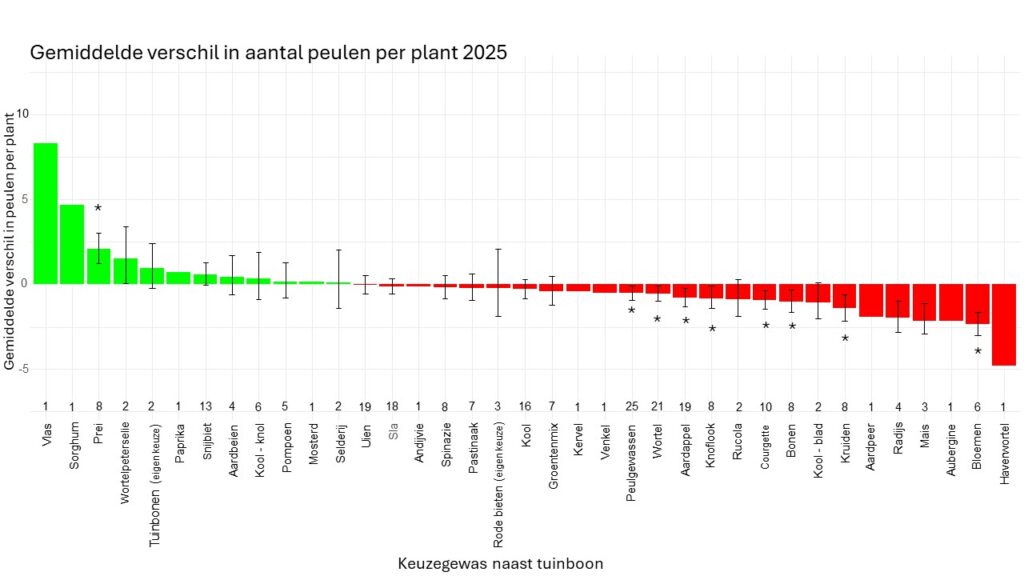
All selected crops for which we have received harvest data are included in the graph. This means that some scores are based on only one or a few gardens. The frequency with which the crop occurred is indicated for each crop by the small numbers below the bars in the graph. In general, the lower the number, the more uncertain the result, because there were too few gardens with that crop.
Statistical analysis
When the selected crop occurred at least five times, we performed a statistical analysis to see what effects we could prove. This test shows that there are nine crops alongside which the beans produce a significantly better or worse (number of pods) than the beans alongside the red beets. The nine significant differences found are marked with an * in the graph.
Footnote: 1) Significant could be interpreted as “meaningful”, but in statistics it means that we are 95% certain that an effect exists and that it is therefore not a coincidence.
Good and bad neighbours
Leek appears to be a significantly better neighbour for broad beans than red beet– resulting in higher bean yields – while legumes, carrots, potatoes, garlic, courgettes, beans, herbs and flowers are significantly worse neighbours for broad beans compared to red beet.
It is striking that there are more neighbouring crops that result in a poorer yield of broad beans than crops that result in a better yield of broad beans, compared to red beet. Leeks are the only crop that scored significantly positive this year, while legumes (sugar snap peas, garden peas, capuchin peas), carrots, potatoes, courgettes, beans (running beans, string beans), herbs and flowers scored worse than red beet as companion crops for broad beans. It is apparently difficult to beat the combination of beetroot and broad beans.
Comparison with 2024
It is also striking that last year's good neighbours (celery, spinach and legumes) are not scoring as well this year or, in the case of legumes, are even significantly worse than the broad bean-red beet combination. Relatively poorer neighbours from last year (flowers, beans, onions, carrots and maize) are again not performing well this year. Whereas courgette was the best neighbouring crop last year (albeit not significantly), this year it is significantly worse than red beet.
The results also show that sufficient data is important in order to draw reliable conclusions. It should be noted that last year, all combinations were compared with broad bean-pumpkin, not with broad bean-red beet.
Would you like to read more on the results from the first year? Read the results of 2024 here.
Pollinators, aphids, and natural enemies
To assess which crops are good and bad neighbours for broad beans, we previously shared the results with you regarding yield (see the results page on the website). However, we did not only examine the yield of the broad beans, but also looked at pollinators, aphids and their natural enemies. What did we find? You can read about it below.
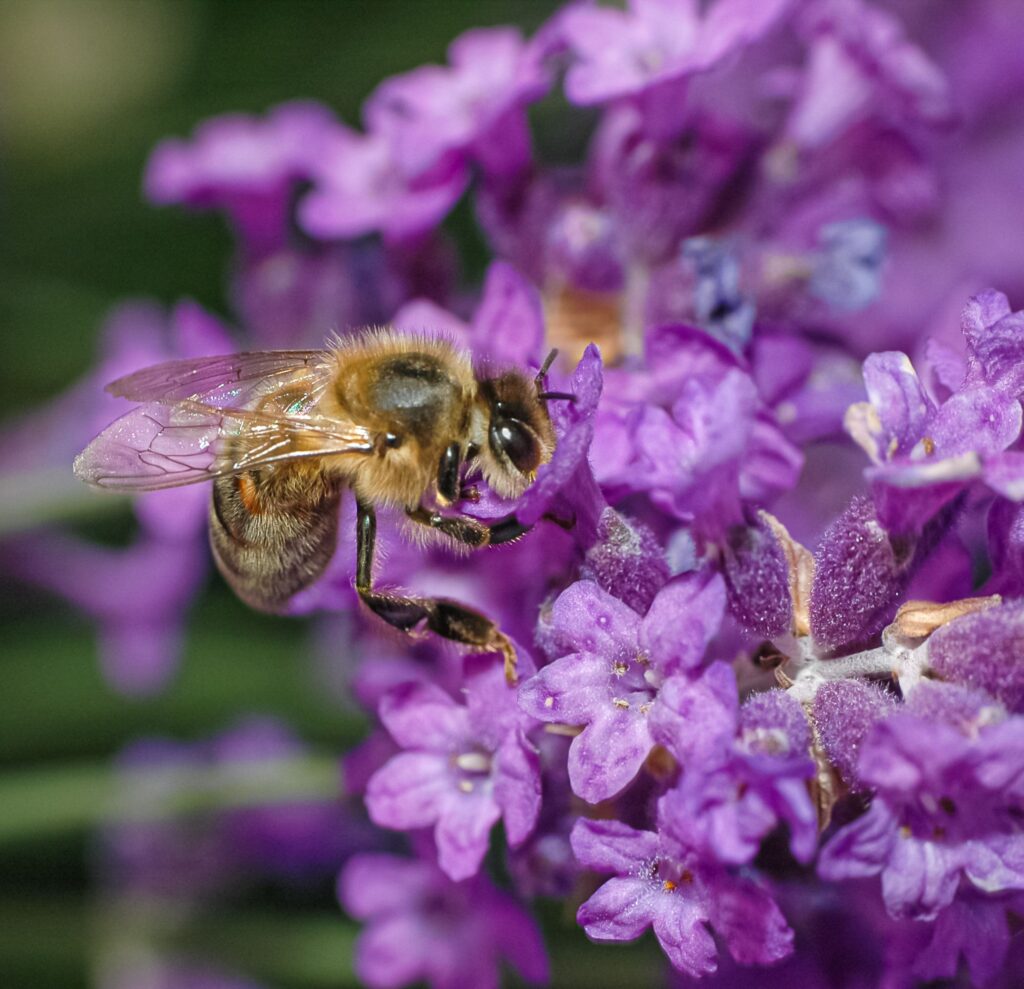
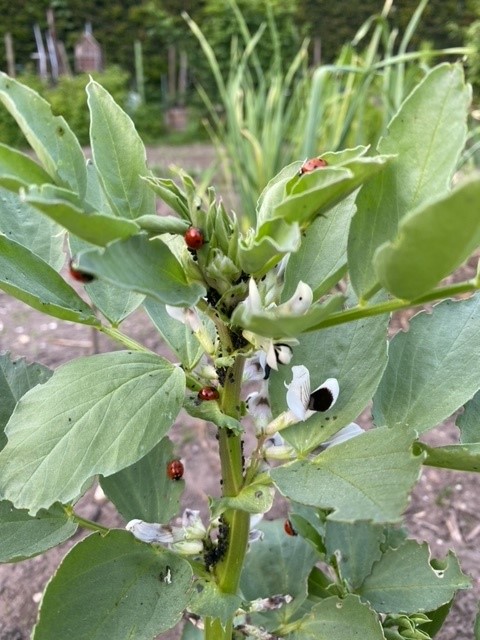
Photo: Hans Smid.
For all measurements, we consistently examined the difference between the broad beans next to the selected crop and the broad beans next to the red beets in the same garden. We examined how many more/fewer pollinators and natural enemies were present or how much higher/lower the aphid score was.
Coincidence or not?
Again, this difference alone does not tell the whole story. If we want to draw conclusions about how good or bad a particular choice crop is as a neighbour to broad beans, it is important that a choice crop has been tested by several people. The more, the better. Only then can we say with more certainty that the results are not a fluke. In the graphs below, the number above the choice crop indicates how many participants have tested this crop and provided data on the subject.
Statistical tests enable us to calculate whether a result is coincidental or whether there is actually a difference. The crops for which it is likely that the broad beans growing next to them actually performed better or worse than those next to the red beets are indicated in the graphs with an asterisk (*). We have done this for all crops that were tested by at least five participants. For the sake of completeness, each graph shows all crops that were tested, including those that only occurred once.
Pollinators
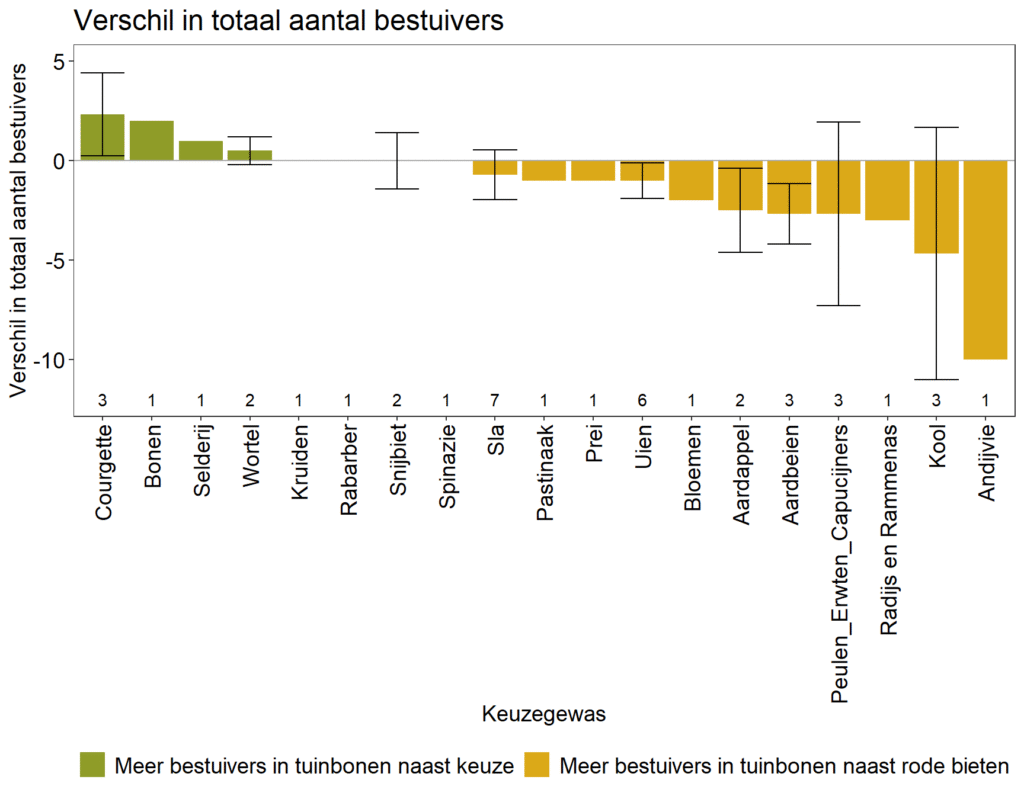
The graph below shows a difference score, i.e. how many more or fewer pollinators were counted in total on the broad beans next to the various choice crops than on those next to the red beets. The choice crops where the broad beans received more visits from pollinators than the broad beans next to the red beets are shown in green. Yellow indicates the crops next to which the broad beans received fewer visits from pollinators than the broad beans next to the red beets.
Red beet is not a bad neighbour
You can see that most broad beans next to selected crops attracted fewer pollinators than broad beans next to red beets. The exceptions to this are the selected crops courgette, beans, celery and carrots. The broad beans next to these selected crops seem to attract slightly more pollinators than broad beans next to red beets. Unfortunately, due to the small number of participants who reported pollinator counts for these selected crops, it is not possible to verify whether these are coincidental results.
Thanks to the statistical analysis of all candidate crops in comparison with red beets, we can cautiously conclude that red beets are a better neighbour to broad beans for attracting pollinators than the candidate crops tested.
Aphids
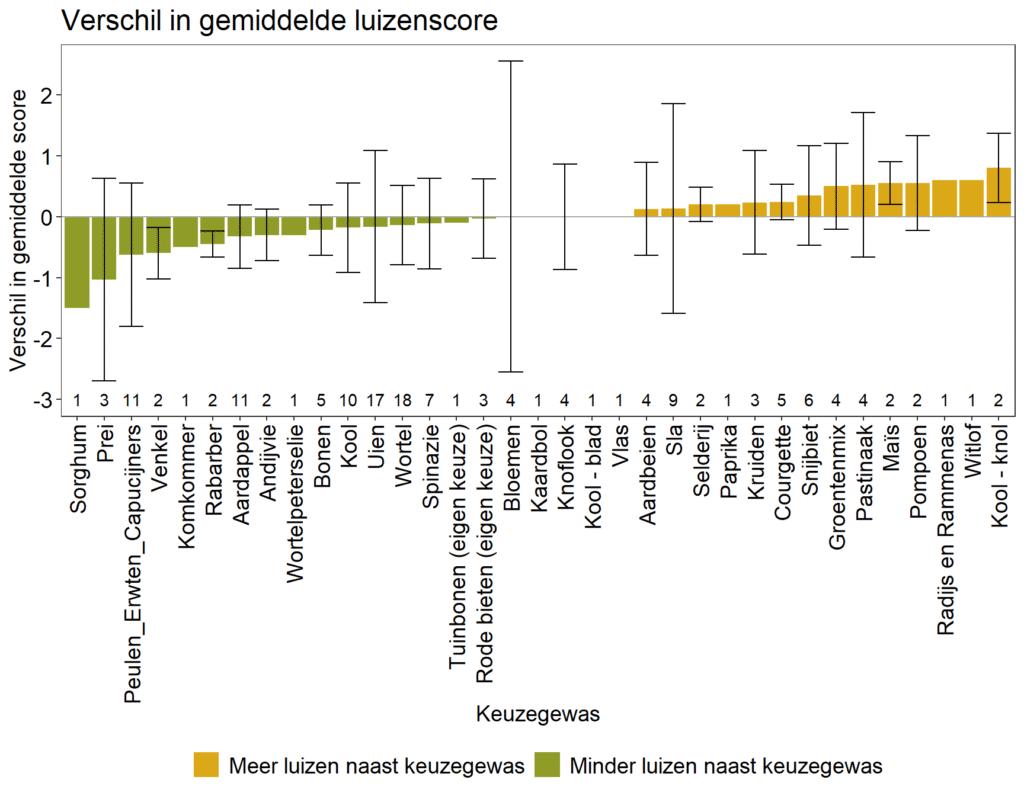
To assess how badly the broad beans were affected by aphids, we used a score from 0 to 5. A score of 0 means “no aphids” and a score of 5 means that more than half of the plant was covered in aphids. For each garden, we compared whether the score for the broad beans next to the selected crop was higher or lower than the score for the broad beans next to the red beets. In this case, higher scores are worse, because they indicate more aphids in the broad beans next to the selected crop. The selected crops next to which broad beans were more affected by aphids are shown in yellow in the graph below. The crops next to which the broad beans suffered less from aphids on average are shown in green. You can see that the broad beans next to leeks, for example, had fewer aphids than those next to beetroot, but that broad beans next to parsnips suffered more from aphids than those next to beetroot.
Comparison with 2024
In 2024, beetroot was a popular choice of crop alongside broad beans, compared to pumpkin. Fewer aphids were observed in broad beans grown alongside beetroot than in broad beans grown alongside pumpkin. This year, beetroot again appears to be a better neighbour than pumpkin. The broad beans next to pumpkin suffered from aphids more on average than those next to red beet. Due to the small number of participants who reported results for pumpkin, we cannot yet substantiate this statistically. However, it is valuable to see that the average effects in both years point in the same direction.
Controlling aphids
Although pest infestations were not as bad in 2025 – fortunately no snails like in 2024 – quite a few participants actively combated lice. The graph below shows the most popular ways of doing this. The most commonly chosen methods for combating aphids are spraying the plants with a solution of green soap in water, usually combined with a dash of methylated spirits, or simply trying to spray the aphids off the plant with the garden hose. Topping the broad beans was also widely practised. Some participants decided to support the natural enemies by releasing ladybird larvae onto the broad beans themselves, thereby suppressing the aphid infestation.
Natural enemies
With the arrival of aphids, natural enemies such as ladybirds also come to the broad beans. That is why we also looked at the number of natural enemies of aphids on the broad beans. Once again, we calculated the difference between the total number of natural enemies next to each crop and next to beetroot. In the graph below, green indicates broad beans next to crops where more natural enemies were counted than next to beetroot, and yellow indicates crops where fewer natural enemies were counted than next to beetroot.
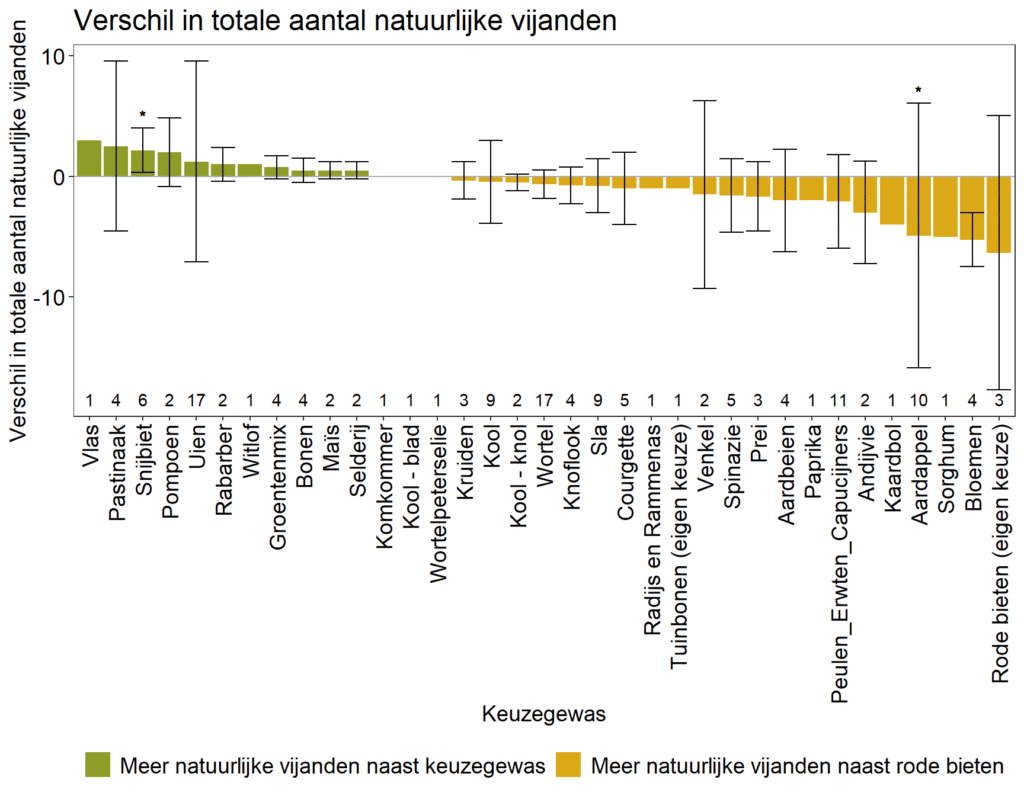
As with pollinators, red beets appear to be a better neighbour for broad beans than most other crops. We have even been able to statistically demonstrate that broad beans grown alongside red beets attract more natural enemies than broad beans grown alongside other crops combined. In the case of potatoes, we have even been able to demonstrate that broad beans grown alongside potatoes attracted fewer natural enemies than broad beans grown alongside red beets.
On the other hand, we were able to prove that broad beans attract more natural enemies when grown alongside Swiss chard than when grown alongside beetroot. This is quite surprising, given that beetroot and Swiss chard are very closely related crops and belong to the same plant species.
Comparison season 2024 and season 2025
Since we have used MoestuinMix for the second season, we can now also make a comparison between 2024 and 2025. In 2024, pumpkin was the standard companion crop alongside broad beans, but beetroot was the most popular crop of choice. That is why we decided to use beetroot as the standard crop last year.
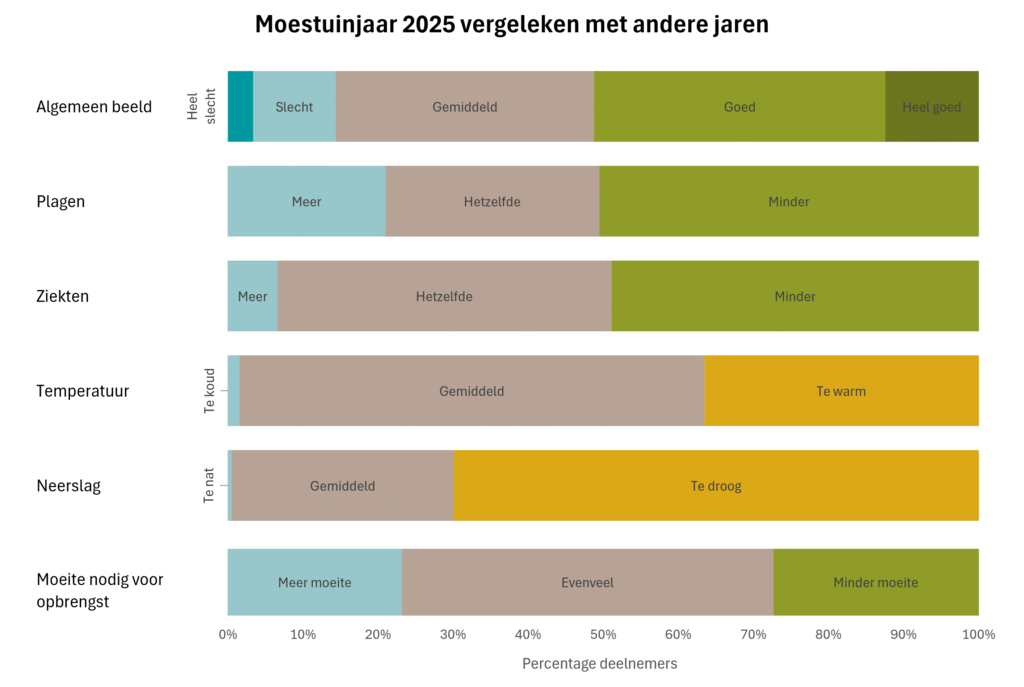
In contrast to the wet year of 2024, when many participants lost their harvests due to large numbers of snails, 2025 was an average to good year. The graph below shows the experiences of participants. Fortunately, most participants had little trouble with pests or diseases. It was a relatively warm and dry year, which meant that most participants (89%) had to water their crops. Fortunately, most participants managed to get a good yield from their broad beans.
MoestuinMix is a citizen science project in which non professional vegetable growers and gardeners experiment with different crop combinations.
In collaboration with

More information
Would you like to know more or do you have questions? Please contact us via moestuinmix@wur.nl.
For news and updates, follow CropMix on LinkedIn
Frequently asked questions
I participated in 2024 or 2025. Can I join again?
Certainly! We will repeat the experiment in 2026. Anyone can participate, including people who did not participate in 2024 or 2025. Registration for 2026 is now open!
Who is behind MoestuinMix?
Researchers from Wageningen University & Research coordinate CropMix, a five-year research programme, and the experiments in MoestuinMix. Here, we work together with AVVN samen natuurlijk tuinieren.
Why do you ask the help of vegetable gardeners?
A vegetable or kitchen garden is pre-eminently a place where crop diversity is high, but there are also big differences between gardens. For instance, in soil type, type of environment and which crops are grown. This provides interesting data.
Moreover, vegetable gardeners often have a lot of valuable knowledge about combining crops. We like to retrieve that knowledge to see what insights could be useful for arable farmers.
What is the goal of the experiment?
Our aim is to learn more about crop diversity and how it works in practice in a vegetable garden or in a field. We are specifically looking for crop combinations that promote cultivation and the processes that ensure this. This knowledge could be important for farmers who want to work with crop diversity in their fields.
What is the role of AVVN?
AVVN samen natuurlijk tuinieren is a partner in the CropMix consortium. We work together in building the MoestuinMix experiments, aimed at people with a kitchen garden.
Is you question not answered above? You can send us an email at moestuinmix@wur.nl.
MoestuinMix is a collaboration between CropMix and AVVN samen natuurlijk tuinieren.